Sympoietic Thinking
December. 2024
Workshop + Learning Design
with Eda Adıgüzel
This workshop was guided by a central pedagogical question: How can documentation reveal agency, productivity, and coexistence within urban environments? Designed as an experiment in collective learning across differences, the workshop brought together first-year and fourth-year undergraduate students from architecture, interior architecture, and industrial design. The learning structure emerged directly from my pedagogical observations in both first-year and fourth-year studio settings, where openness to exploration and technical proficiency often operate in parallel but rarely intersect. I intentionally structured the workshop around mixed-experience teams, pairing two first-year students, whose curiosity and speculative thinking shaped early inquiry, with two fourth-year students, whose technical competence supported materialization and testing. Rather than treating experience level as a hierarchy, the workshop reframed it as a shared pedagogical resource, enabling learning to circulate multi-directionally through peer interaction and guided collaboration.
The conceptual framework of the workshop was informed by relational and posthuman theories articulated by Bruno Latour and Donna Haraway, particularly their critiques of binary distinctions such as nature and culture or human and non-human. At the same time, the learning design drew on situated and experiential theories of learning, treating knowledge as something that emerges through participation in context rather than abstract instruction. In this sense, the workshop functioned as a temporary community of practice, where dialogue, mediation, and coexistence were not theoretical themes but conditions deliberately designed and sustained within the learning environment. Using Yıldız Park as a living laboratory, students collectively observed and documented diverse life practices along designated walking routes. I coordinated a process in which these observations were recorded through drawing, mapping, photography, and notation, and subsequently translated into three-dimensional models that articulated shared expressions of collective existence. This process aligned with experiential learning approaches in which movement, perception, and reflection are intertwined,
and documentation functions as a mode of inquiry rather than a representational endpoint.
By foregrounding documentation as an active design practice, students were encouraged to recognize symbiotic relationships between human and non-human actors and to integrate these dynamics into speculative design propositions. Throughout the process, design was positioned as a dialogic act, resonating with critical pedagogical traditions that understand learning as co-produced through interaction rather than transmitted unidirectionally. In my role as a teaching assistant at Bahçeşehir University, I assumed responsibility for both the intellectual framing and the coordination of the workshop, from structuring group dynamics to facilitating collective reflection and evaluation. Working closely with students, I cultivated a learning environment in which theory and experience continuously informed one another. This workshop strengthened my understanding of learning design as the intentional coordination of diversity, dialogue, and collective making, and reinforced my commitment to pedagogical models that foreground relational thinking and shared agency within design education.
![]()
Figure 1. A collective three-dimensional model produced through hands-on
experimentation, translating observations of human and non-human relations into
a material articulation of sympoietic thinking and shared agency.
![]()
Figure 2. Student-generated photographic documentation used as an
epistemic tool for close observation, foregrounding texture, materiality, and
micro-scale interactions as starting points for situated learning and design
inquiry.
![]()
Figure 3.
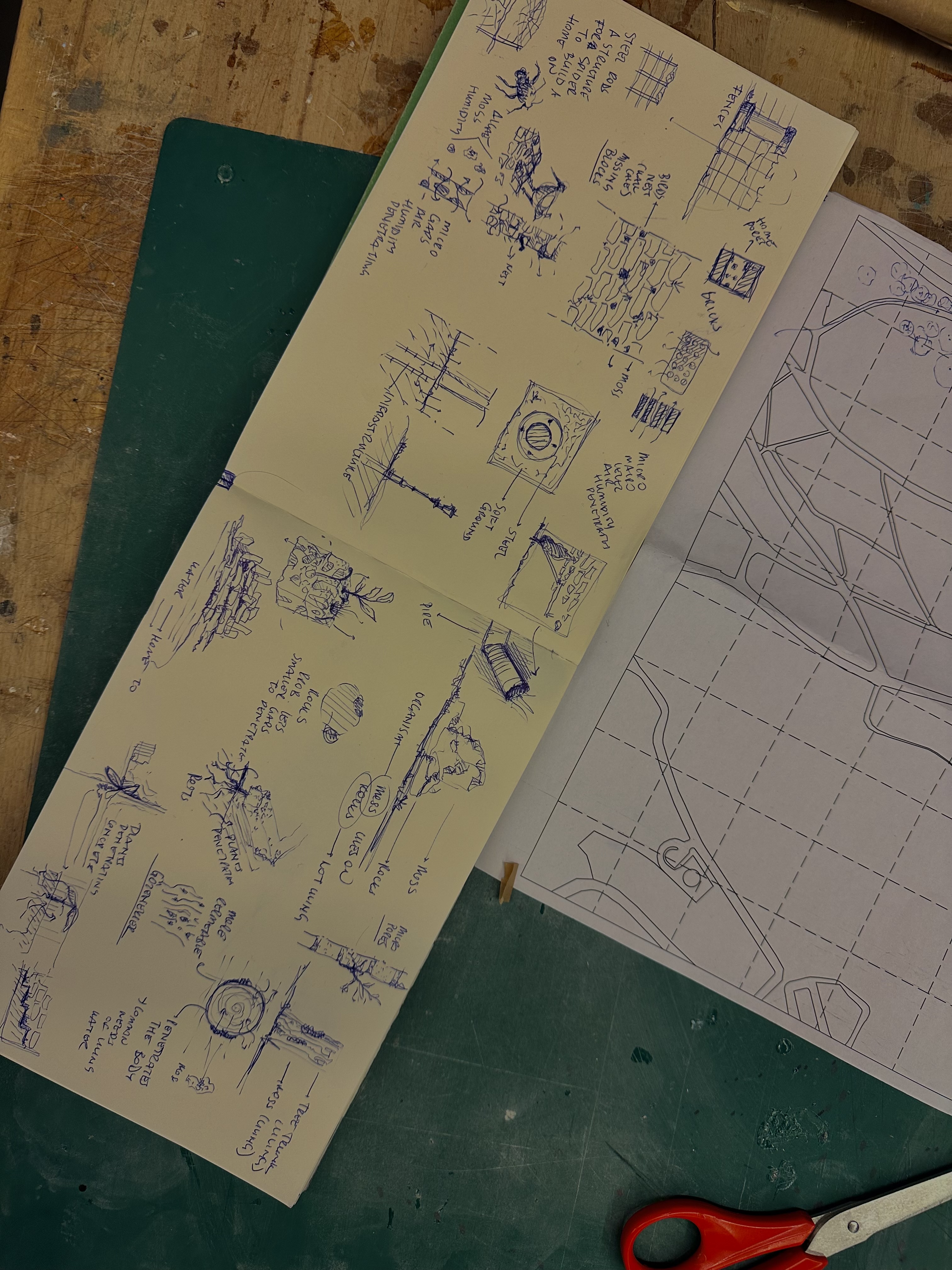
Students translated field observations into analytical sketches, using drawing as an investigative bridge between embodied experience and spatial reasoning.
![]()
Figure 4.
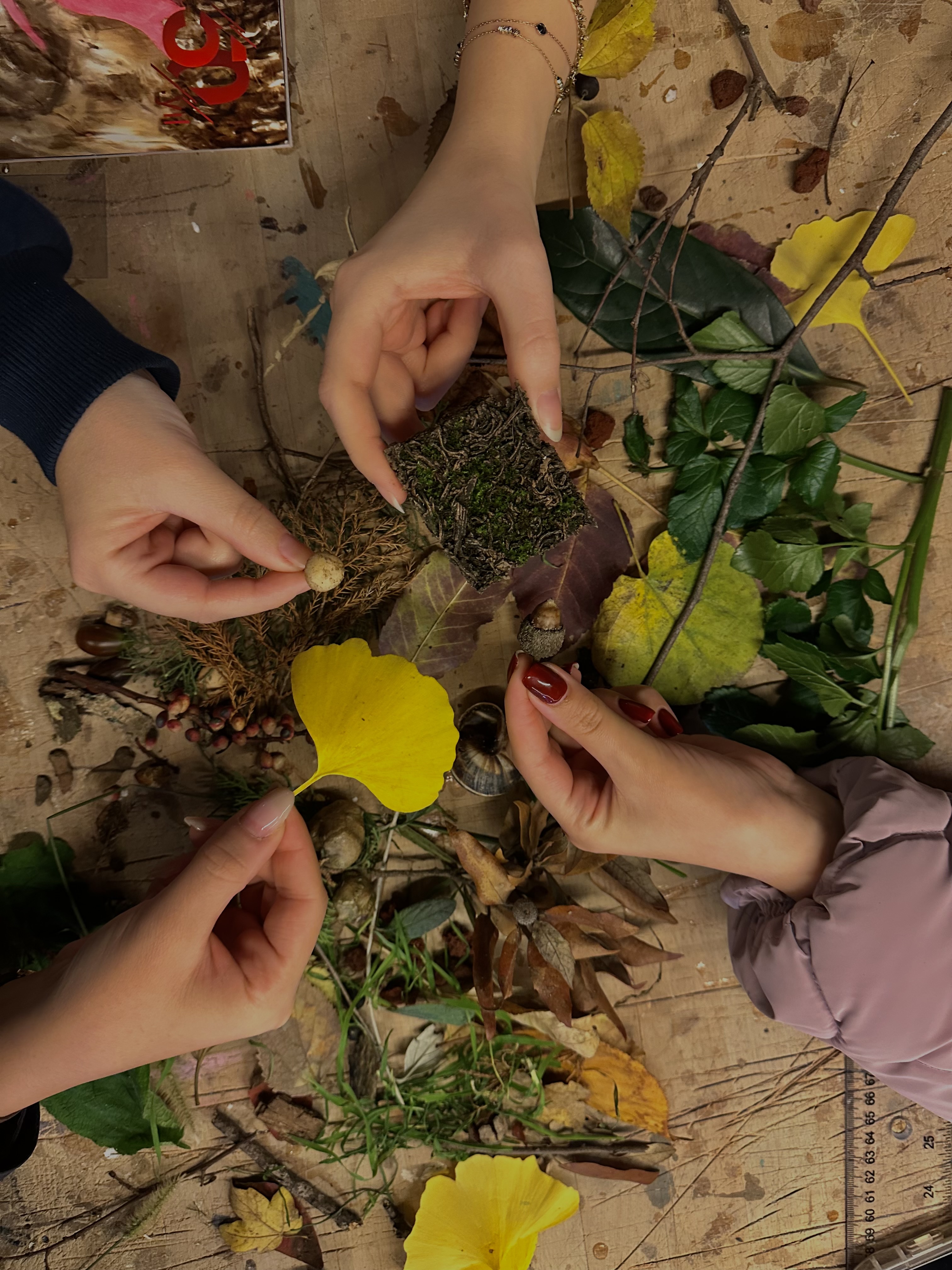
Students engaged in tactile documentation of organic materials, foregrounding relational dynamics between human and non-human actors.
![]()
Figure 5.
Students gathered at the end of the Sympoietic Thinking workshop, celebrating a shared process of dialogue, curiosity, and collective learning.